Showing posts with label 廣東話. Show all posts
Monday, December 6, 2010
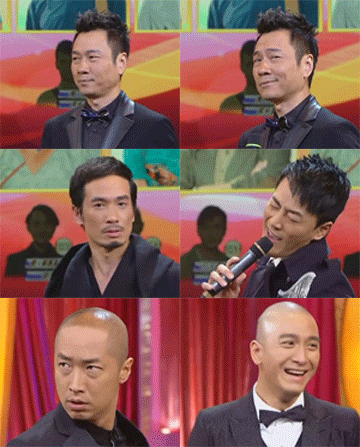
"Chok" Look
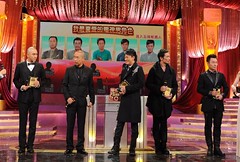
Wayne Lai, Moses Chan, Raymond Lam, Steven Ma, and Kenneth Ma's "chok" look at TV Awards Presentation 2010 during the 'My Favourite TV Male Character' top five segment.
Definition of "chok":
"Chok" is derived from the English word "choke". It is used to describe one's exaggerated behaviour, attitude or voice such that it makes people feel asphyxiated.
Personal Note: Raymond and Moses looked the most "chok". Ha ha.... However, Ma Ming's was the most funny! :P
Labels:
Kenneth Ma 馬國明,
Moses Chan 陳豪,
Raymond Lam 林峯,
Steven Ma 馬浚偉,
廣東話
Friday, June 11, 2010
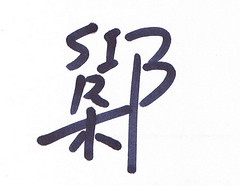
瀡 Sir

The definition of 瀡 (sir):
瀡 is an ancient character. It means 'slide', and it may also be used to indicate a sound (i.e., 'slurp').
Personal Note: Surprised that the 'sir' character can been written in Chinese! However, still prefer Benz Hui's way of writing it in "Love Undercover". He he.... :D
Fong Chung Sir's way of writing 'Sir'.
Monday, December 7, 2009
囧 Gwing
囧 was first popularized in Taiwan discussion forums, and it was later used by Hong Kong netizens to describe Myolie Wu's facial expression in "The Master of Tai Chi" and "When a Dog Loves a Cat".The definition of 囧 (gwing):
囧 is a facial expression used to describe one's mood. It can be helpless, shocked, stunned, frustrated, depressed, strange, speechless, etc.
Related post: 《囧探查過界》 "Twilight Investigation" @ TVB Sales Presentation 2010
Personal Note: Whose gwing look will look gwing-er? Ha ha.... :PLooking forward to "Twilight Investigation"! :D
Tuesday, October 24, 2006
廣東話 7
Lesson 7:
痴(chi) 痴(chi) 地(dei) - 傻的意思 (crazy, kind of dumb)
o翕(ngup) 乜(mat) 鬼(gwai) - 說什麼 (what are you talking about?)
渣(ja) 渣(ja) 臨(lam) - 快的意思 (hurry up)
搞(gaau) 乜(mat) 春(chun) - 做什麼東西 (what are you doing?)
瓜(gwa) 老(lo) 襯(chan) /瓜(gwa) /瓜(gwa) 柴(chaai) - 死亡的意思 (die)
騎(ke) 呢(ne) - 奇形怪相 (funny-looking, weird)
痴(chi) 痴(chi) 地(dei) - 傻的意思 (crazy, kind of dumb)
o翕(ngup) 乜(mat) 鬼(gwai) - 說什麼 (what are you talking about?)
渣(ja) 渣(ja) 臨(lam) - 快的意思 (hurry up)
搞(gaau) 乜(mat) 春(chun) - 做什麼東西 (what are you doing?)
瓜(gwa) 老(lo) 襯(chan) /瓜(gwa) /瓜(gwa) 柴(chaai) - 死亡的意思 (die)
騎(ke) 呢(ne) - 奇形怪相 (funny-looking, weird)
Thursday, October 5, 2006
廣東話 6
Lesson 6:
廢(fai) 柴(chaai) - 形容一個人是廢物﹐很無用 (it is to describe a person who is useless)
收(sau) 皮(pei) ﹐ 收(sau) 爹(de) - 叫人走開,滾開或不要出聲的意思 (telling someone to 'shut up' or 'go away')
大(daai) 鑊(wok) - 糟糕, 大事不妙 (meaning 'oh no!')
茂(mau) 尼(lei) - 傻傻地﹐衰人 (person who is a jerk, evil, not nice--a 'PK' person)
粉(fan) 腸(cheung) - 看一個人不順眼時的形容詞, 意思是他唔會好得去邊
芥(gaai) 蘭(laan) - 同'粉腸'差不多意思 (can use for name calling; it doesn't have a specific meaning--nothing good can come out of it)
Personal Note: I had fun coming up with these ones. '粉腸' is actually the food--rice noodle. I actually made up '芥蘭'. It is actually a Chinese vegetable called 'Chinese kale'. My mom was holding 4 Chinese kales up and said she was going to cook them. It just sounded funny; it seemed as though she was calling us '4 Chinese kales' (四條芥蘭). I found out that the slang 「炒芥蘭」 (chaau gaai laan) is for soccer. It came from the English term for 'charley horse'.
廢(fai) 柴(chaai) - 形容一個人是廢物﹐很無用 (it is to describe a person who is useless)
收(sau) 皮(pei) ﹐ 收(sau) 爹(de) - 叫人走開,滾開或不要出聲的意思 (telling someone to 'shut up' or 'go away')
大(daai) 鑊(wok) - 糟糕, 大事不妙 (meaning 'oh no!')
茂(mau) 尼(lei) - 傻傻地﹐衰人 (person who is a jerk, evil, not nice--a 'PK' person)
粉(fan) 腸(cheung) - 看一個人不順眼時的形容詞, 意思是他唔會好得去邊
芥(gaai) 蘭(laan) - 同'粉腸'差不多意思 (can use for name calling; it doesn't have a specific meaning--nothing good can come out of it)
Personal Note: I had fun coming up with these ones. '粉腸' is actually the food--rice noodle. I actually made up '芥蘭'. It is actually a Chinese vegetable called 'Chinese kale'. My mom was holding 4 Chinese kales up and said she was going to cook them. It just sounded funny; it seemed as though she was calling us '4 Chinese kales' (四條芥蘭). I found out that the slang 「炒芥蘭」 (chaau gaai laan) is for soccer. It came from the English term for 'charley horse'.
Thursday, August 24, 2006
廣東話 5
Lesson 5:
戇(ngong) 居(gui) - 單純﹐有“傻”﹐“呆”之意 (ingenuous, naive, simple, silly, straightforward)
拾(sap) 戇(ngong) - saying someone is ingenuous, naive, simple, silly, straightforward
無 (mo) 賴 (laai) - 下流﹐“卑鄙小人”的意思 (rascal, jerk)
一(yat) 舊(gau) 飯(faan) - 即是好像一團飯﹐呆呆的樣子
拾(sap) 下(ha) 拾(sap) 下(ha) - “傻下傻下”﹐傻傻地 (silly,dumb)
豬(jue) 兜(dau) or 豬(jue) 嘜(mak) - 意思就是笨 (dumb, stupid)
樣(yeung) 衰(sui) - 很醜的意思 (funny-looking, ugly)
死(sei) 蠢(chun) - 超級之笨 (extremely stupid)
戇(ngong) 居(gui) - 單純﹐有“傻”﹐“呆”之意 (ingenuous, naive, simple, silly, straightforward)
拾(sap) 戇(ngong) - saying someone is ingenuous, naive, simple, silly, straightforward
無 (mo) 賴 (laai) - 下流﹐“卑鄙小人”的意思 (rascal, jerk)
一(yat) 舊(gau) 飯(faan) - 即是好像一團飯﹐呆呆的樣子
拾(sap) 下(ha) 拾(sap) 下(ha) - “傻下傻下”﹐傻傻地 (silly,dumb)
豬(jue) 兜(dau) or 豬(jue) 嘜(mak) - 意思就是笨 (dumb, stupid)
樣(yeung) 衰(sui) - 很醜的意思 (funny-looking, ugly)
死(sei) 蠢(chun) - 超級之笨 (extremely stupid)
Thursday, August 3, 2006
廣東話 4
Lesson 4:
老(lo) 餅(beng) - 老土, 時代過後 (oldie, old-fashioned)
驢(law) - 老土 (oldie, old-fashioned)
木(muk) 篤(duk) - (wooden)
好(ho) 醒(sing) - 聰明 (smart)
死(sei) 蠢(chun) - 非常之笨 (very stupid, dumb)
o拿(na) o拿(na) 聲(seng) - 快 (fast, hurry up)
Personal Note: I sometimes don't pronounce '好醒' as 'ho sing'; I say 'ho sung'. As well as '死蠢', I say 'si chun' instead. The word 驢(law) actually means donkey, but in Cantonese slang, it means old-fashioned. In the movie "Mummy Age 19", Tsui Tin Yau of Shine used it. Benz Hui, Kingdom Yuen, and Mak Dau boy played his father, mother, and brother in that movie. Benz asked, "What does 驢(law) mean?" The little boy replied, "Law, l-a-w呀!" Then Kingdom said, "呵﹐法律". They actually thought it meant 'law'. It was so hilarious!
老(lo) 餅(beng) - 老土, 時代過後 (oldie, old-fashioned)
驢(law) - 老土 (oldie, old-fashioned)
木(muk) 篤(duk) - (wooden)
好(ho) 醒(sing) - 聰明 (smart)
死(sei) 蠢(chun) - 非常之笨 (very stupid, dumb)
o拿(na) o拿(na) 聲(seng) - 快 (fast, hurry up)
Personal Note: I sometimes don't pronounce '好醒' as 'ho sing'; I say 'ho sung'. As well as '死蠢', I say 'si chun' instead. The word 驢(law) actually means donkey, but in Cantonese slang, it means old-fashioned. In the movie "Mummy Age 19", Tsui Tin Yau of Shine used it. Benz Hui, Kingdom Yuen, and Mak Dau boy played his father, mother, and brother in that movie. Benz asked, "What does 驢(law) mean?" The little boy replied, "Law, l-a-w呀!" Then Kingdom said, "呵﹐法律". They actually thought it meant 'law'. It was so hilarious!
Tuesday, July 11, 2006
廣東話 3
Lesson 3:
黐(chi) 線(sin) - 神經病 (crazy)
懶(laan) 醒(sing) - 自作聰明 (smart aleck)
叻(lek) or 勁(ging) - 聰明 (smart)
豬(jue) 頭(tau) 炳(bing) - 蠢 (dumb, not so smart)
賤(jin) 人(yan) - 無品 (cheap)
貓(maau) 樣(yeung) - 奇貌不樣 (funny-looking)
黐(chi) 線(sin) - 神經病 (crazy)
懶(laan) 醒(sing) - 自作聰明 (smart aleck)
叻(lek) or 勁(ging) - 聰明 (smart)
豬(jue) 頭(tau) 炳(bing) - 蠢 (dumb, not so smart)
賤(jin) 人(yan) - 無品 (cheap)
貓(maau) 樣(yeung) - 奇貌不樣 (funny-looking)
Wednesday, June 28, 2006
廣東話 2
Lesson 2:
俾(bei) 人(yan) 飛(fei) - 被人拋棄 (dumped)
吹(chui) 水(sui) - 作大 (exaggerate)
巴(ba) 巴(ba) 閉(bai) 閉(bai) - 威風﹐了不起﹐驕傲之意 (arrogant meaning)
扭(nau) 柴(chaai) - 扭親﹐扭傷 (sprain)
麻(ma) 麻(ma) 地(dei) - 過得去 (okay to pass)
大(daai) 頭(tau) 蝦(ha) - 粗心大意 (careless)
俾(bei) 人(yan) 飛(fei) - 被人拋棄 (dumped)
吹(chui) 水(sui) - 作大 (exaggerate)
巴(ba) 巴(ba) 閉(bai) 閉(bai) - 威風﹐了不起﹐驕傲之意 (arrogant meaning)
扭(nau) 柴(chaai) - 扭親﹐扭傷 (sprain)
麻(ma) 麻(ma) 地(dei) - 過得去 (okay to pass)
大(daai) 頭(tau) 蝦(ha) - 粗心大意 (careless)
Wednesday, June 21, 2006
廣東話
This section is influenced by Sammul Chan. The Cantonese dialect is very different from Mandarin because it uses a lot of slang.
Lesson 1:
o訓(fan)﹕即係睡覺 (sleep)
早(jo) 透(tau)﹕即晚安 (good night)
玩(waan)﹕氣弄意思 (E.g., 你玩我! vs. 你氣弄我!) (fool)
豬(jue) 扒(pa)﹕醜 (ugly)
削(seuk)﹕殘
Lesson 1:
o訓(fan)﹕即係睡覺 (sleep)
早(jo) 透(tau)﹕即晚安 (good night)
玩(waan)﹕氣弄意思 (E.g., 你玩我! vs. 你氣弄我!) (fool)
豬(jue) 扒(pa)﹕醜 (ugly)
削(seuk)﹕殘
Subscribe to:
Posts (Atom)